Sunday, April 20, 2014
Maxwell House Ad by Wieden + Kennedy
Wieden + Kennedy has come out with yet another great ad, this time it's an average guy talking about how Maxwell House coffee is just 'good'. In an era that is over saturated with superlatives - "awesome," "incredible," "amazing"- it's rather underwhelming to hear a product be described as just "good". However this ad differentiates itself and makes "good" seem well... desirable. While it is a risky move admitting that your product isn't top of the line, I think the producers did a great job injecting some humor into the ad to quell that possible negative perception.

Pedigree's Latest Campaign
Pedigree recently came out with it's new #sharefordogs campaign, in which they are raising money for dogs in need via this YouTube video:
Youtube has a feature called Monetization, that allows whoever uploaded the content to earn 55% of advertising revenue based off of ads placed on the page. The more views the video receives, the more advertising revenue Pedigree will earn, hence the #sharefordogs hashtag. Pedigree uses 100% of the revenue to feeding, treating, and finding homes for dogs in need. It's refreshing to see a company take an approach that gives back. This a great example of a company utilizing PR to the full extent. Pedigree has established itself not just as a maker of dog food, but a company that cares about the well-being of dogs everywhere.
Friday, April 18, 2014
Tools for Fellow Marketers
For my fellow digital marketers, I came across a few tools I think you all would find extremely useful. Quicksprout.com provides great insight into web analytics, SEO, social media presence, and more.
First off is the Definitive Guide to Copywriting by Neil Patel and Joseph Putnam. This guide teaches you how to write useful and engaging content with the end goal of converting more readers to customers. There are ten chapters that span everything from writing good copy to combining good copy with good design. Very useful tool.


First off is the Definitive Guide to Copywriting by Neil Patel and Joseph Putnam. This guide teaches you how to write useful and engaging content with the end goal of converting more readers to customers. There are ten chapters that span everything from writing good copy to combining good copy with good design. Very useful tool.
Second, is The Beginner Guide to Online Marketing. The authors claim: "Online marketing moves at the speed of light. To keep up, you need a strong foundation with the judgment to think critically, act independently, and be relentlessly creative. That’s why we wrote this guide — to empower you with the mental building blocks to stay ahead in an aggressive industry." This guide consists of 14 chapters of pure gold. Go read it.
Lastly is an article on Growth Hacking. Some very useful tips/trick on how to pull people in and engage/retain them.
Growthhacking
In the digital world, marketing is constantly changing along with our assumptions and impressions. According to growthhackers.com
"Online marketing is undergoing rapid changes in response to near realtime feedback loops that reveal the effectiveness of marketing programs. Rapid testing, iteration/optimization and aggressive scaling of things that work define an effective customer acquisition approach today. While all marketers are becoming more agile, the growth hacking community is focused on extreme agility and using all available levers to drive sustainable growth."
There are many different ways to utilize growth hacking, whether it be through email receipts, content creation, or SEO Strategy, there is a plethora of ways to build your business digitally. Growthhackers.com provides a forum where fellow growth hackers can provide tips and tricks to other digital marketers. Jimmy Daly recently submitted a post regarding email receipts and how to utilize them as a marketing tool. Jack Dorsey, co-founder of twitter recently posted his idea on email marketing:
“What if we see the receipt more as a publishing medium — a product unto itself that people actually want to take home, that they want to engage with, be fully interactive with?”
Unfortunately, email receipts tend to be huge missed opportunities. Daly offers several ways email receipts could result in a little extra revenue:
1. Include a call to action
2. Partner up with another store
3. Lead customers to a retail location
4. Offer partnered ads
5. Link a referral program
Wednesday, April 9, 2014
Facebook's Flawed Advertising Platform
The user began noticing that the people who liked his page, also liked thousands of other pages and were particularly disengaged-similar behavior to the likes you receive from like farms. These 'fake likes' behave much differently from 'real likes' as they do not engage (like, comment, or share) your posts. While Facebook claimed to get rid of 83 million 'fake accounts' in 2012, there are still a considerable mass of fake accounts who've managed to avoid Facebook's Fraud Algorithims. How? In order to avoid detection, click farms like pages other than the ones they've been paid for to seem more genuine. It would be very easy to spot fake likes stemming from one geographic region to another in a matter of hours, but mixed in with a slew of other 'like' activity, it would be impossible to identify. So why is this such a big deal? These fake likes are worse than useless, they detract from your page.
When you make a post, Facebook distributes it to a small fraction of the people who like your page just to gauge their reaction. If they engage your post by liking, commenting, or sharing it, then Facebook distributes the post to more of the people who like your page. However, if you amass a number of fake likes, then Facebook's original distribution goes out to fewer real fans resulting in lower engagement, consequently reaching a smaller audience. This is how a rising number of likes can result in lower engagement. So ultimately Facebook makes you pay twice, once to acquire new fans, and another time to engage them.
Sunday, March 23, 2014
Book Review: You Are Not So Smart by David McRaney
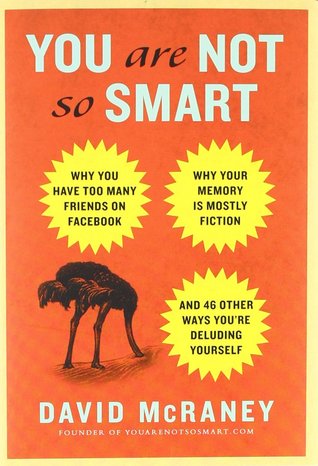
I just finished reading You Are Not So Smart, a book examining a multitude of ways in which we are deluding ourselves. The book argues that every decision we make, every emotion we feel, is wrapped around a story we tell ourselves to explain them, but often times these stories aren't true. By pointing out numerous ways in which we fool ourselves, You Are Not So Smart promotes the idea that while we think we are rational beings whose every decision is based on logic, our emotions and psyche cause us to make choices that follow no rational logic whatsoever.
Here are a few gems I took away from the book:
Apophenia: defined as the experience of seeing patterns or connections in random or meaningless data. McRaney argues that while we think some coincidences are so miraculous they must have meaning, they are really in fact random events and any meaning applied to them comes from your mind. He adds that apophenia is "the result of the most dependable of all delusions--the confirmation bias."
Brand Loyalty is the result of a need to rationalize past choices to protect your sense of self. The author illustrates "it's the choosing of one thing over another that leads to narratives about why you did it, which usually tie into your self-image." So while we become proud fanboys over certain products in our life, when we engage with others to tell them why our product choice is superior, our intent is not to change their mind, but rather to prop up our own.
I'd highly recommend this book to anyone seeking to better understand themselves and others. It's 48 ways in which we delude ourselves, shortly summarized in one to five pages each. Go check it out.
Subscribe to:
Posts (Atom)